Showing posts with label etymology. Show all posts

Tuesday, February 6, 2007

The Four-Letter Film - F*ck (2005)

"Oh, Boone!"

If you slammed your hand in the car door, is this the sort of interjection you'd use? Absolutely not. You or I would probably have no qualms about dropping the f-bomb. But Pat Boone, who is featured as one of the talking heads in Steve Anderson's documentary, F*ck, uses his own last name in place of the most powerful word in the English language.

Anderson's documentary examines various facets of the word: its etymology (the word's history is still a mystery); the political ramifications of its use, particularly in today's "culture wars"; its obvious application to sexual situations; and, its versatility (it can be used as a noun, verb, adjective, adverb, and, yes, as an interjection). The dissecting of "fuck" is presented through that commonplace documentary vehicle--a series of interviews with people who are presumably learned on the subject of the film. While this documentary technique is far from original, Anderson uses it well by assembling a list of experts from all walks of life and from all points on the political spectrum. Boone is among several interviewees from the right wing, along with Alan Keyes, Michael Medved, and Dennis Prager. Interviewees from the more liberal end of the spectrum are primarily comedians: Drew Carey, Billy Connolly, Janeane Garofalo, and Bill Maher, among others. In between are several experts in the English language, such as Jesse Sheidlower, principal editor of the Oxford English Dictionary, and Reinhold Aman, a scholar who researches "verbal aggression." The end product is a funny, informative, and engaging examination of what the freedom to use this word means to the vitality of our society.

Unfortunately, my review of this documentary comes a bit late for those of us who reside here in Indianapolis, as the film ended its run at Key Cinemas on Saturday. It is, however, available on DVD and would be well worth adding to your Netflix queue. Locals should encourage Rick and Keith at Mass Ave Video to add it to their outstanding selection of independent films and documentaries if they don't already have it in stock. I'm sure that it won't take much to persuade them to do so.

Thursday, February 1, 2007

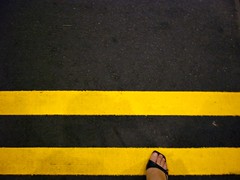
Toeing the line

This week, I was reading an article in a very well-known daily publication. The author of the article wrote that a member of a particular political group was "towing the party line." After I read the sentence, I stopped, paused for a moment, and read again. I realized then that the author had made a very common mistake: he mistook one homophone for another.

Homophones are words that are pronounced the same but have different meanings. Homophones typically have different spellings. In this instance, the writer confused the homophones "tow" and "toe." In other words, the writer should have written that the members of the political group were "toeing the party line," not "towing the party line."

So what does the phrase "toe the line" mean, and where did it originate? According to Merriam-Webster, "toe the line" means "to conform rigorously to a rule or standard." As for the etymology of the phrase, English language maven Michael Quinion gives this explanation:

Toe the line is actually the survivor of a set of phrases that were common in the nineteenth century; others were toe the mark, toe the scratch, toe the crack, or toe the trig. In every case, the image was that of men lining up with the tips of their toes touching some line. They might be on parade, or preparing to undertake some task, or in readiness for a race or fight.

So the next time you use this idiomatic expression, make sure that you toe the line.

Post script: The online version of the article in which the incorrect usage of the phrase appeared has since been edited to eliminate the phrase completely.

Sources:

Wednesday, January 24, 2007

Hoosier

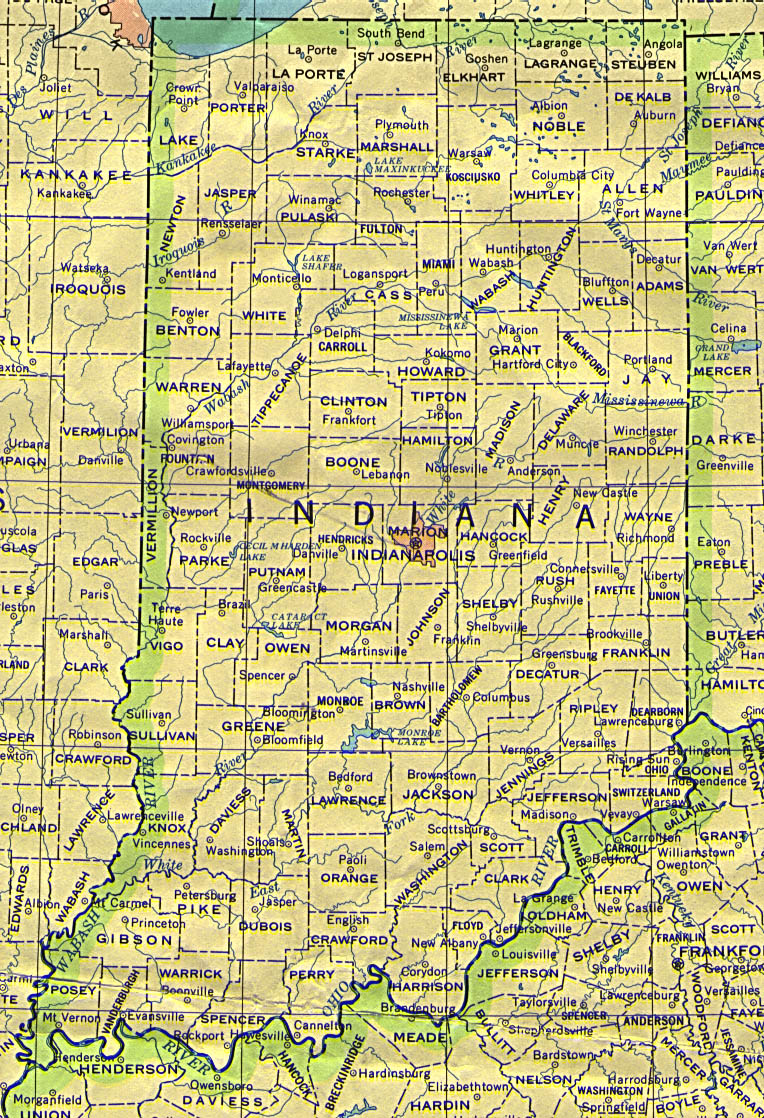
As an Indiana native and resident, I thought I'd start with a discussion of a term that most of us who live here see or hear on at least a weekly basis: Hoosier.

In the most widely understood sense, "Hoosier" refers to a native of Indiana. Most of us here don't affix any sort of pejorative meaning to the term, although I came from the northwest part of the state, where very few people refer to themselves as Hoosiers or even use the term. I suppose this is so because Northwest Indiana residents typically think of themselves as Chicagoans, not Indiana folk.

But in the rest of the state, the word is used pretty frequently. Indiana University sports teams are called the Hoosiers. The state lottery isn't called the Indiana Lottery; it's called the Hoosier Lottery. Before the age of corporate naming rights for sporting facilities, the RCA Dome was known as the Hoosier Dome. Rock Bottom Brewery even offers a beer called Hoosier Ma Stout, the logo for which is a quaint picture of a frontier couple standing in front of a log cabin. And before the Indiana high school basketball tournament was divided into a class tournament, the single-class tournament was often referred to as Hoosier Hysteria.

I have heard the term used as a slight a few times. When Bob Knight was coach of the IU basketball team, he became angry (surprise, right?) when Northwestern fans taunted the coach by asking him, "Hoosier daddy?" And when I was in Southern California to visit a friend a few years ago, we were called "f***ing Hoosiers" by a drunk patron in a Santa Barbara bar. This incident was unusual because the guy had no idea we were Indiana natives, unlike the taunting Northwestern students, who knew that the coach was connected with IU.

All sources note that the history of "Hoosier" is a cloudy one. According to the OED, the word has been used since the late 1820's. However, no one has been able to pinpoint the true genesis of the word. Explanations range from the facetious to the serious. On the serious side, here's the American Heritage Dictionary's etymology of "Hoosier":

[T]he most likely possibility is that the term is an alteration of hoozer, an English dialect word recorded in Cumberland, a former county of northwest England, in the late 19th century and used to refer to anything unusually large. The transition between hoozer and Hoosier is not clear.

On the facetious side, here's an excerpt from an article that appeared in the July/August 1992 edition of Indiana Alumni Magazine, in which author Diane Carmony describes the etymology of the word through the eyes of Indiana poet James Whitcomb Riley:

Hoosier pioneers fought so violently, Riley contended, that noses were bitten off and eyes jabbed out during these brawls. "Hoosier," said Riley, descends from the question posed by a stranger after entering a southern Indiana tavern and pushing a piece of human flesh with his boot toe: "Who's ear?"

So how about it, Indiana natives? Do you proudly refer to yourselves as "Hoosiers"?

Sources: